- BOHÈME SAUVAGE -
Le Journal - Magazine for Sophisticated
Entertainment, Edition N° 7 - 1920
NUDE CLIMBING WITH HERMANN
HESSE
Marie de Winter visits the nature people at Monte
Verità, English version of selected articles
- Nature Boys - The tensions of
modern life are producing a new breedof
atomic-age hermits, in: PIX magazine of 1950
- Icon
of Lebensreform, from BoTSL* 2015
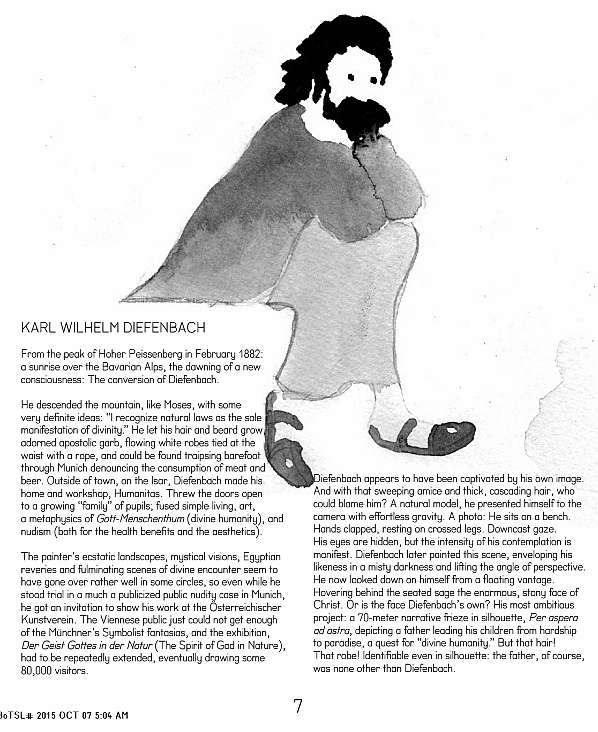
- Karl
Wilhelm Diefenbach (1851-1913), Gusto's
earstwhile teacher
- Lebensreform
("life reform"), by Peter Crawford, 2013
- A short summary of
Gusto Gräser's life and ideas "Dress
Down Friday: Gusto Gräser" by James Conway
- What the Daily Press Newport News said in
1907 on Flower Power in Ascona
- Ur-hippies
from
Germany to California, blog 2011
- Report from the 10th Otto Gross
Congress in Moscow 2017
- Gottfried M. Heuer: Freud’s
‘Outstanding’ Colleague/ Jung’s ‘Twin Brother’:
The suppressed psychoanalytic and political
significance of Otto Gross, 2017
- The Dance Must Go
On: Planetary
Dance (Today's Gräser dances?)
- Monte Verità and
Gusto Gräser in "The Childrens Book" by A.S.
Byatt, 2009
- Philipp Blom, The
Vertigo
Years, Europe 1900-14: Cultural, economic,
political life before 1st World War, Weidenfeld & Nicolson,
London 2008
- A
leading light of ‘Modern Dance’ Mary Wigman
however, became the most influencing European
Choreographer of her time
- An early follower
of Gusto Graeser, Raymond Duncan, an American in
Paris 1949
- 1967 - 1999: Monte Verità , a
collection of texts
- Leopold Wölfling
wrote about the Gräsers, and mainly brother Ernst
Graeser in 1931:"Vögel the Third"
- Robert Levine: Looking for stories
- Martin
Green, 1986: A Cave in the Rocks, from
"Mountain of Truth"
> Summary
- Daphne du Maurier, 1963: Excerpts
from the novel "Monte Verità"
- Dr.
Anna Fischer- Dückelmann Critiques Female
Medicine on Monte Verità, by Paulette Meyer 2006
- The
Influence of Ascona's Monte Verità on
- American counter-culture of the 1960's
- New Age
By Michael Minnicino
- The
Origin of Hippie in Europe 1880 to 1940, by Anne
Hill Fernie (Ragged University)
This talk
was given at ‘Gullivers’ on Oldham Street in
Manchester 20th April 2015
- Gustavo
Bernardo Galvão Krause (* 1955, Rio
de Janeiro)
Krause has published poems
and novels. His novel Monte Verità (2009),
translated from Portuguese:
The Hill of Truth: Monte
Verità
is the most beautiful tale regarding our moral
relationship towards the environment and each
other. But there are no easy answers. What do a
hill in Switzerland, a polyglot waiter from
Mozambique and a Brazilian professor have in
common? What can be done, and when should we
start?"
- Thesis
by Claudia Wagner on Gusto Gräsers teacher Karl
Wilhelm Diefenbach, Freie Universität Berlin,
October 2007
- From James M. Powell's Blog
on "The Glass Bead Game" by Hermann Hesse
In this review, I share my
thoughts on two spectra within the rainbow of
knowledge the novel's main character, Knecht,
lives: .... Hesse
learned of from his spiritual teacher, the naturmensch,
pacifist, poet, painter, and antiwar activist
Gustav (Gusto) Gräser. Read more ...
- Gustav Gräser
(1879-1958), A Transylvanian Saxon Follower of
the Movement "Back to Nature" and co-founder of
the Monte Verità Colony, by Gudrun-Liane Ittu
(romanian)
-
Gusto's erstwhile teacher
Karl Wilhelm Diefenbach on "Strange Flowers",
January 2012
- Hibberd, Dominic on Harold Monro,
extract on his time on Monte Verità, Ascona,
Switzerland
- Eduard
"Buddha" von der Heydt who bought the Monte
Verità in 1926

Gusto and others in:
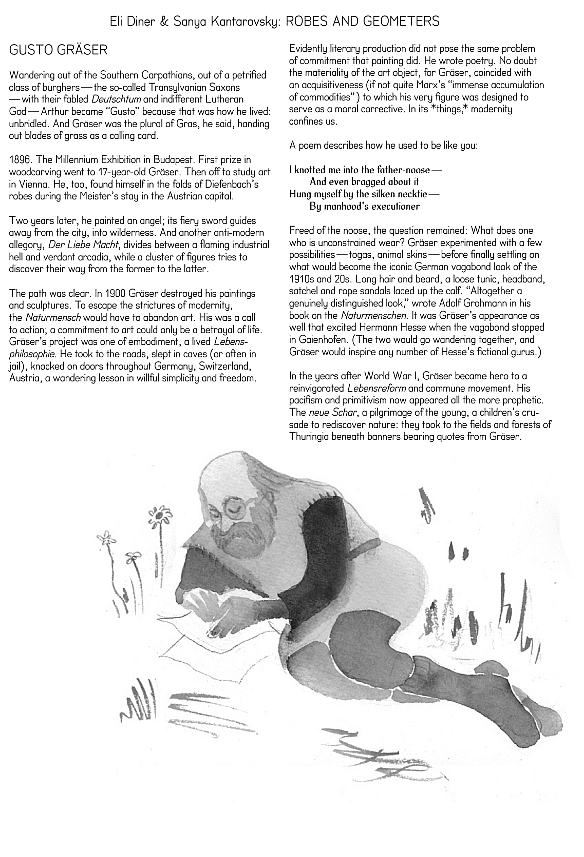
Eli Diner & Sanya Kantarovsky:
ROBES AND GEOMETERS
Two countervailing tendencies: The additive and
the subtractive. Futurist and primitivist.
|